Nexus Market 2026 — Features, Security & Access Guide
This Nexus Market guide is for security research and privacy education. It explains the platform's features, escrow, security model and safe-access habits so you can protect yourself online. Read, learn, apply the habits.
This is the full 2026 guide to Nexus Market: what the platform is, the features that earned it a top-2 spot, how its multisig escrow works, the security architecture, and how to reach it safely over Tor. For the current verified onion, jump to our verified Nexus market link page anytime.
About Nexus Market
Nexus Market launched on 22 November 2023 with 500 users and a clear thesis: a darknet marketplace could win on experience, not just inventory. Fourteen months later it held the top-2 position. The growth curve is unusually clean — 500 at launch, 10,000 registered users by Q1 2024, 1,000 verified vendors by Q2, top-5 status by Q3, and the top-2 spot secured by Q4 2024. Through 2026 the platform has sustained a base above 50,000.
What did the market get right to climb that fast? Three things, mostly. It shipped an interface people actually wanted to use — the cyberpunk visual identity is described in public analysis as industry-leading. It built mobile-first, so the marketplace works on a phone over Tor rather than fighting the screen. And it handed real governance to its community through a DAO. Inventory and security it matched against the field; experience and governance is where Nexus Market pulled ahead.
Today the platform hosts 2,500+ vendors (1,800+ active, 85% verified, 4.7/5 average rating) across 25,000+ listings, serving 15,000+ daily active users at a 99.5% uptime figure. Those numbers describe a stable, established marketplace — which is what most people running an "is nexus legit" search are really trying to confirm.
Nexus Market Feature Deep-Dive
The feature set rewards a closer look, because the headline items each solve a real problem rather than padding a list.
Cyberpunk interface
A dark, neon-accented design tuned for Tor Browser's dark mode. Beyond looks, a clear layout reduces user error — and on a darknet market, fewer mistakes means fewer lost accounts. Readability is a quiet security feature.
Mobile-first design
The platform's signature. The interface is fully responsive, so buttons stay tappable, text stays readable, and nothing scrolls sideways on a phone over Tor. Most markets bolt mobile on as an afterthought; Nexus built for the small screen first.
DAO governance
A decentralized model where registered members propose features, vote on policy, shape the roadmap and take part in community arbitration. The marketplace is steered, in part, by the people using it.
AI-powered support
An AI layer answers routine questions instantly, which keeps average response time under two hours even at this scale. Hard cases still reach human staff.
Beyond the four headliners, Nexus Market runs a built-in forum (market discussion, vendor announcements, security advisories), lightning-fast search with advanced filters, personalized recommendations, favorites and wishlists, full order tracking, and localization into 15+ languages. Small features, stacked, are why customer satisfaction sits at 4.6/5.
How Nexus Market Escrow Works
Escrow on Nexus Market is multisignature, and the step-by-step is simpler than the term suggests:
- You order and pay into escrow. The payment goes to a multisig address that needs more than one key to release — not straight to the vendor.
- Funds are held while the order ships. Neither party can quietly pull them out; the keys are split.
- You confirm receipt and funds release. Once the order arrives as described, the payment goes to the vendor.
- If something is wrong, you open a dispute. Structured resolution — backed by community arbitration under the DAO — mediates the outcome, with refund policies and vendor bonds in play.
The reason multisig matters: no single party controls the money alone. That protects a buyer against a vendor walking off mid-order and against a single point of failure on the platform side. Paired with end-to-end encrypted messaging on the order, the buyer keeps both privacy and real standing in any dispute. The rule never changes — keep funds in escrow until the goods are in hand.
Nexus Market Security Architecture
Security on the platform splits into two problems, handled separately. Account security is about keeping your login and messages yours. Infrastructure security is about keeping the marketplace itself standing and uncompromised.
On the account side, PGP encryption is mandatory for sensitive communication and 2FA is available on the login. PGP encrypts messages to your key alone — not the vendor's clearnet, not an intercepting layer, not a log. 2FA means a stolen password by itself opens nothing. Those two controls close the first paths an attacker actually tries.
On the infrastructure side, Nexus Market runs a RAM-only database, so sensitive state lives in memory and never persists to disk. The platform sits behind multi-level DDoS protection, distributes across servers with automatic failover, and runs regular penetration testing alongside a bug bounty program and an incident-response team. The marketplace also publishes user-education resources, because the user is usually the weakest link, not the server.
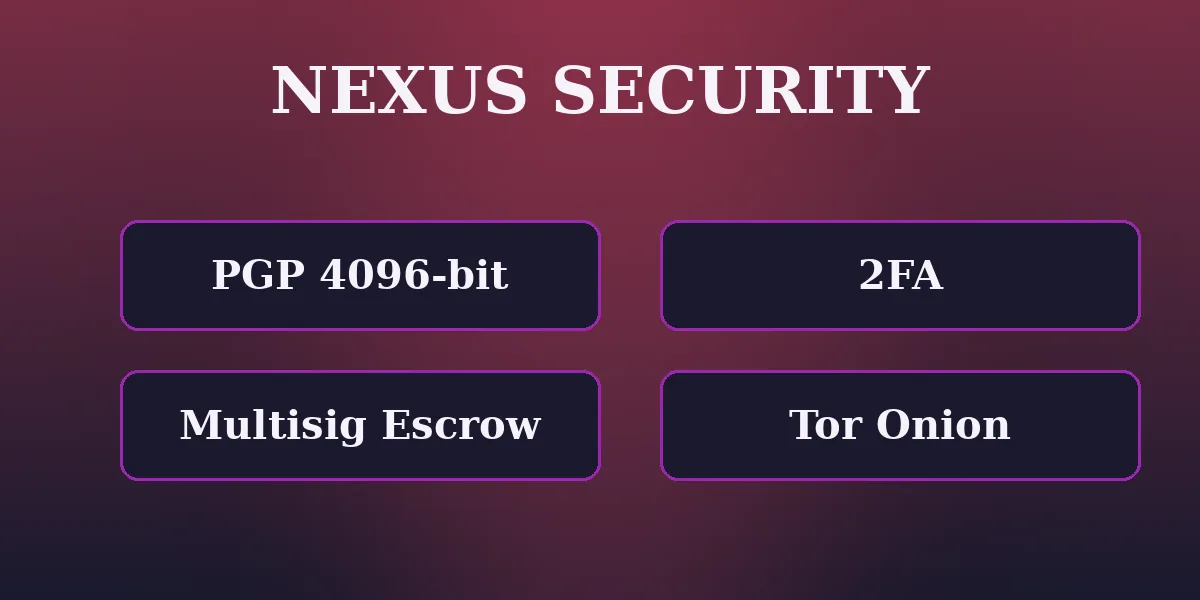
A blunt truth worth repeating: the platform supplies the tools, the user supplies the discipline. Mandatory PGP, optional 2FA and RAM-only storage do nothing for someone who reuses a clearnet password or clicks an unsolicited link. Set the controls up properly and Nexus Market's security architecture works the way it is designed to.
Nexus Market Payments & Privacy
Nexus Market accepts three coins through an integrated wallet with automatic conversion and real-time rates, and the three serve different needs.
Bitcoin (BTC) is the primary currency — most widely held, easiest to acquire, the default for most buyers. Its ledger is public, so on-chain privacy depends on how you handle coins before they reach the marketplace.
Monero (XMR) is the privacy coin. It hides sender, receiver and amount at the protocol level through ring signatures and stealth addresses. Paying in XMR on Nexus Market makes the payment leg private by design rather than by careful handling — which is why privacy-minded users reach for it first.
Litecoin (LTC) is the fast, low-fee option. Confirmations land quickly and fees stay small, suiting smaller or time-sensitive orders.
XMR versus BTC, in plain terms: Bitcoin is convenient and liquid but transparent; Monero is private by default but takes one extra step to acquire. If privacy is the priority, the answer on Nexus Market is Monero. If convenience wins and you handle coins carefully, Bitcoin is fine. The integrated wallet converts between all three at live rates, so you are not juggling external wallets by hand.
How to Access Nexus Market Safely
Safe access to Nexus Market is a routine, and the routine is the protection. Run the same checklist every time:
- Download Tor Browser only from the official Tor Project site — never a mirror or a "modified" build.
- Set the security level to Safest so JavaScript is off site-wide.
- Consider Tails or Whonix on a desktop: Tails is amnesic and leaves nothing behind; Whonix forces every connection through Tor.
- Copy a verified link from the verified Nexus market link page — never from an unsolicited message.
- Verify the PGP signature over the mirror announcement before you connect.
- Use a unique password, stored in an offline manager like KeePassXC.
- Enable 2FA on your Nexus Market account the moment it exists.
- Generate or import a PGP key before your first sensitive message.
- Bookmark the verified links page, not a raw onion address that will rotate.
Because the marketplace is mobile-first, browsing on a phone works — but reserve the Tails-on-desktop session for logging in and moving funds. Match the route to the risk of the moment.
Nexus Market Reputation, DAO & AI Support
Reputation is the thing a marketplace cannot fake for long, and Nexus Market's figures hold up: 4.7/5 across 1,800+ active vendors, 85% verified, 4.6/5 overall satisfaction, 75% return rate. Numbers that survive a 50,000+ user base are the ones worth trusting. Trust is built mechanically — PGP-key verification, identity confirmation, transaction-history review and performance monitoring on the vendor side; escrow, dispute resolution, refund policies and vendor bonds on the buyer side.
The DAO is where Nexus Market diverges most from its rivals. Members propose features, vote on policy and shape the roadmap directly, with community arbitration feeding into disputes. A marketplace that asks its users what to build next, and counts the votes, behaves differently from one that ships changes top-down — and that participation is a large part of the 75% retention figure.
The AI support layer rounds it out: instant answers to routine questions, with human staff for the hard cases, keeping response times under two hours at scale. Put reputation, governance and support together and you have the answer to "is nexus legit" stated as a system rather than a slogan — verifiable vendor ratings, community-steered policy, and responsive support, all visible in the platform itself.
Nexus Market — Frequently Asked Questions
Nexus Market is a top-2 darknet marketplace that launched in November 2023 and now serves 50,000+ registered users with 2,500+ vendors. It is known for a cyberpunk, mobile-first interface, DAO governance, multisig escrow and mandatory PGP, running at a 99.5% uptime figure.
Public OSINT analysis describes Nexus Market as an active, established top-2 platform with a verified vendor base (85% verified, 4.7/5 average), multisig escrow and a strong uptime record. Verify any link's PGP signature yourself and check vendor ratings before transacting.
Its cyberpunk interface, mobile-first design, DAO governance and AI-powered support, plus a built-in forum, fast search with filters, order tracking, wishlists and 15+ language localization.
Multisig escrow holds your payment in an address needing more than one key, releases to the vendor only when you confirm receipt, and routes disputes through structured resolution with vendor bonds and refund policies. No single party can move the funds alone.
The marketplace runs a competitive commission structure for vendors and keeps transaction fees low, with Litecoin available for fast, low-fee payments. Exact figures depend on category and order; check current terms in-platform.
A decentralized model where registered members propose features, vote on marketplace policy, shape the roadmap and take part in community arbitration — giving users a direct say in the platform's direction.
An AI layer answers routine questions instantly and escalates complex cases to human staff, which keeps the average response time under two hours even with 50,000+ users.
Three: Bitcoin (primary), Monero (privacy via ring signatures and stealth addresses) and Litecoin (fast, low-fee). An integrated wallet with automatic conversion and real-time rates ties them together.
Yes — mobile-first is the platform's signature feature. The interface is fully responsive over Tor. For sensitive actions like logging in or moving funds, a Tails-on-desktop session is the safer choice.
Install Tor Browser from the official source, set security to Safest, copy a verified link from our live Nexus market mirrors page, verify its PGP signature, use a unique password with 2FA, and bookmark the verified links page rather than a raw address.
Nexus Market leads on interface, mobile-first design, DAO governance and AI support, matches the field on escrow and core coin support, and adds Litecoin for fast payments. The full side-by-side versus Torzon and DrugHub is on the Nexus Market homepage.
Start with Nexus Market
You have the full picture of Nexus Market — features, escrow, security, payments and access. The next step is the link: head to the verified Nexus Market link page for current mirrors with live status, or back to the homepage for the platform overview and comparison table. Copy a verified address, confirm its PGP signature, then connect.